The right public adjuster software finds claims, signs clients, tracks every file to settlement, proves the loss, and pays your team. Here is what to look for, what to ask in a demo, what it costs, and how Drodat covers each piece.
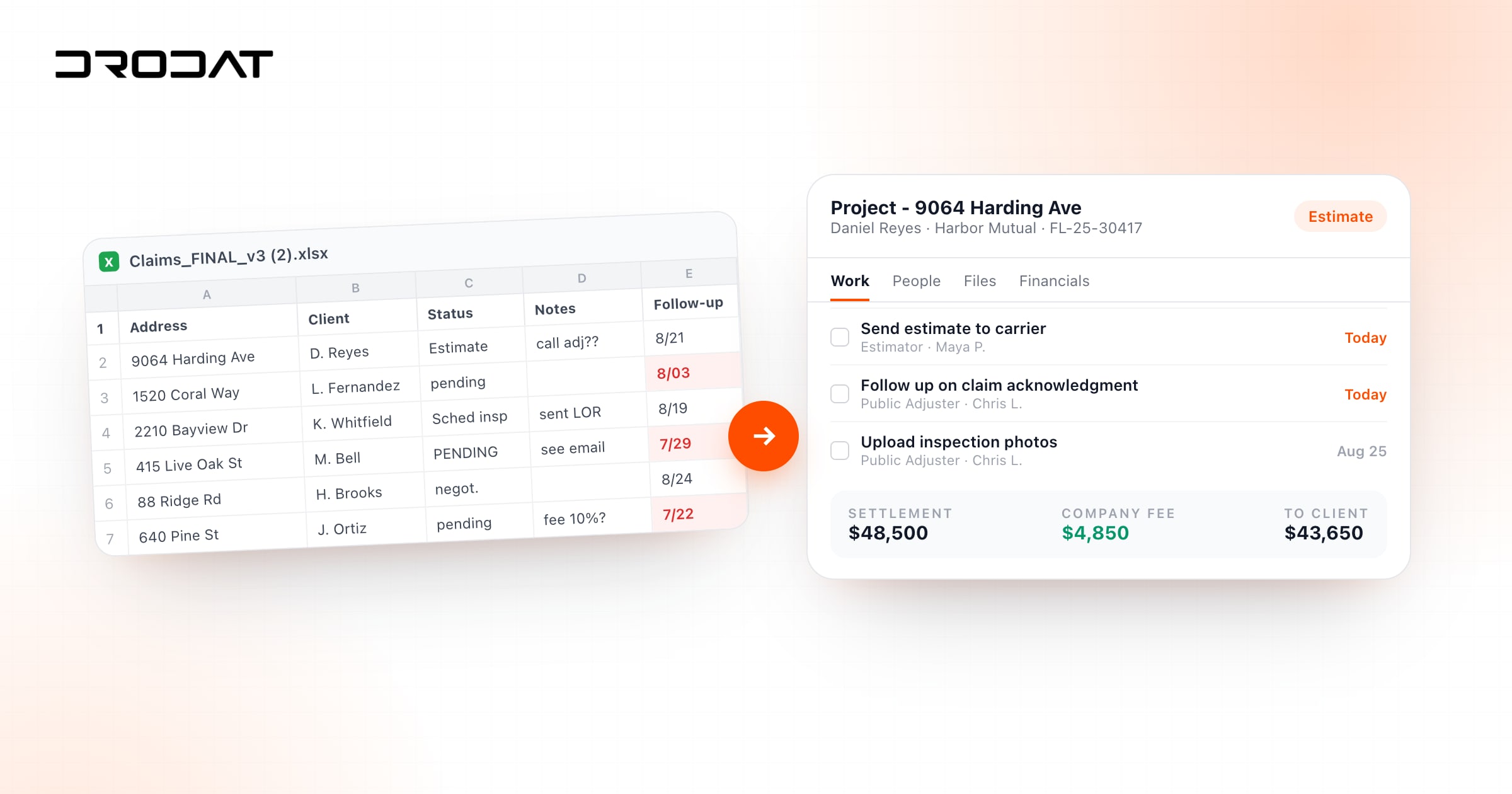
Most public adjusting firms do not run on one system. They run on a lead service, a spreadsheet of active claims, an e-signature tool, a weather report vendor, a shared drive full of photos, a separate CRM, and a second spreadsheet for fees. Every hand-off between those tools is a place where a claim stalls, a deadline slips, or a fee goes uncollected.
Public adjuster software replaces that stack with one system built around the way a claim actually moves: from the first lead to the final check. This guide covers what that software should do in 2026, what to ask before you buy, what it costs, and how to switch without losing a single file.
What is public adjuster software?
Public adjuster software is the operating system for a public adjusting firm. At minimum it is a claims management system and a CRM: every claim is a record with its policyholder, carrier, policy and claim numbers, date of loss, documents, and status. The best platforms go further and bring in the data that wins claims (storm history, weather reports, aerial imagery, permit records) and the money side of the business (fees, client disbursements, team payouts).
The difference matters. A generic CRM can tell you who to call next. Public adjuster software should tell you which storm to work, whether the date of loss holds up, what the roof looked like before the storm, and exactly what you are owed when the carrier pays.
The 9 things public adjuster software should do
1. Find new claims
Your pipeline starts before the client calls you. Look for software that turns storms and fires into a list of addresses you can act on.
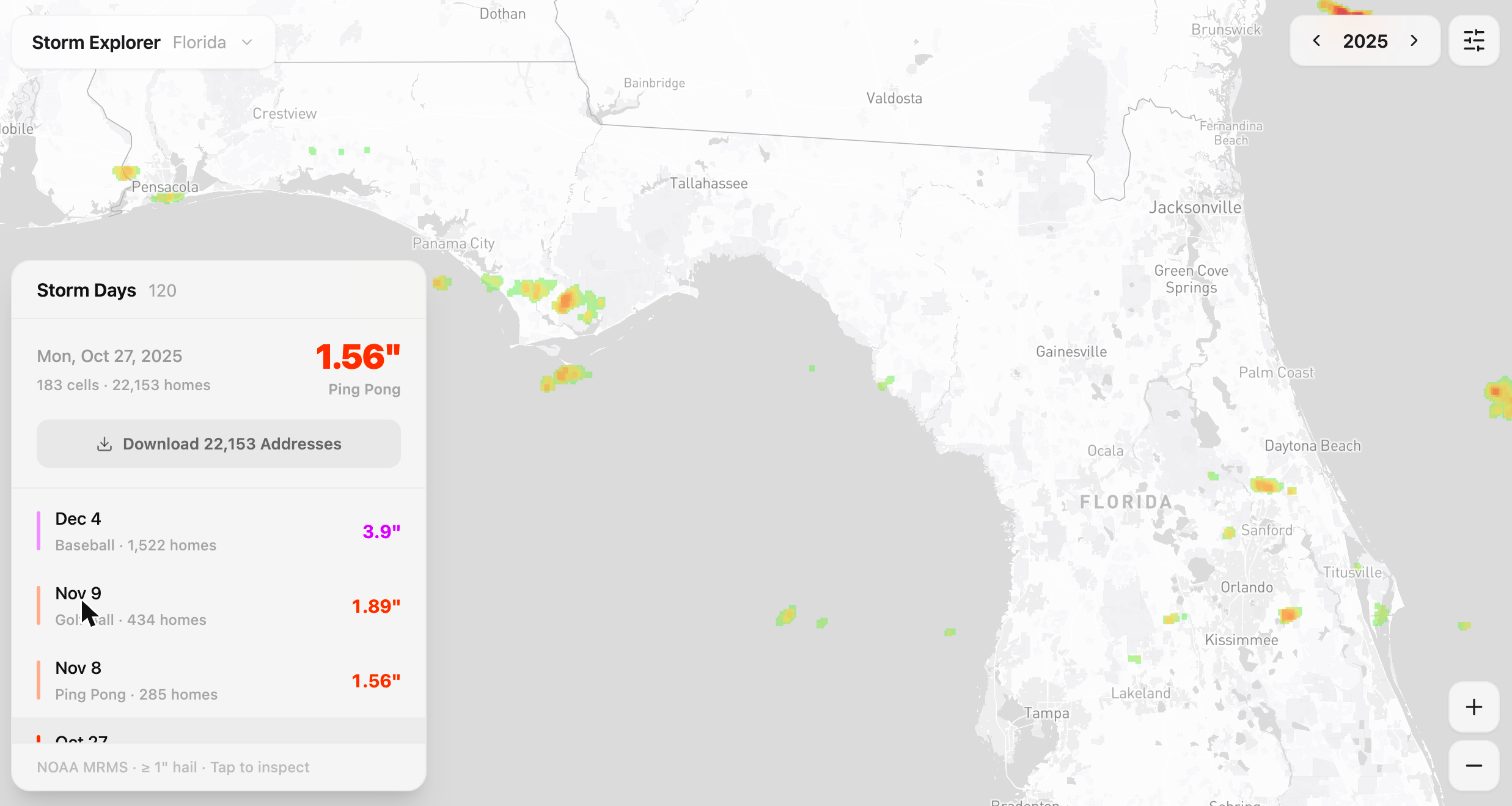
In Drodat, Storm Explorer shows every day with hail of 1 inch or larger in a state and year, maps each storm’s footprint, counts the homes inside it, and exports their addresses with the hail size at each one. Drodat Dispatch sends structure-fire alerts for your territory to your phone, with one public adjusting firm per market.
2. Sign the client fast
The firm that gets the contract signed first usually gets the claim. Your software should capture the client’s information once and send your own contract, already filled in, for e-signature on any device.
Drodat Client Intake captures the client and contacts, the carrier and policy, the date of loss, and scope notes. You can also share a lead form so new clients fill it out themselves. Contracts then sends your own PDF contract, pre-filled from the intake, and keeps an audit trail with timestamps and IP addresses and a certificate of completion.
3. Track every claim in one pipeline
You should be able to see every claim, its stage, and what is due next without opening a spreadsheet. Stages should match how public adjusting really works, including the long tail of appraisal, litigation, and recoverable depreciation.
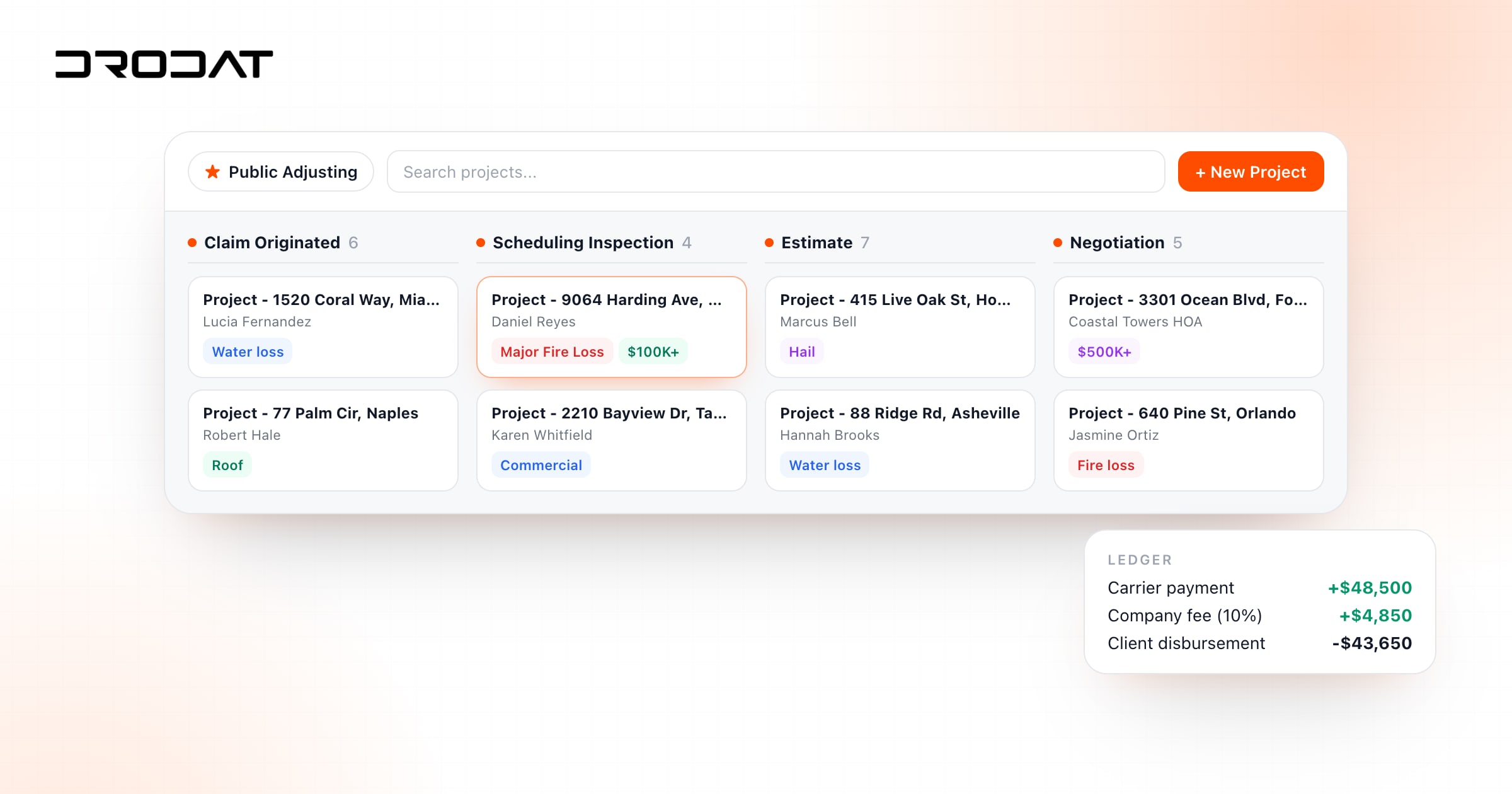
Drodat Projects runs each claim through a pipeline from New Opportunity to Closed: Pending Signature, Claim Originated, Scheduling Inspection, Estimate, Negotiation, Mediation, Appraisal, Litigation, Recoverable Depreciation, Pending Settlement, and Settled. Every move is saved to the claim’s activity history, and you can view the pipeline as a board, a stacked view, or a list.
4. Document the loss
Photos, notes, and inspection findings have to land in the claim file, organized, the moment they are captured. If your team is texting photos to each other, the file is already incomplete.
Drodat AI Inspections let you run an inspection by talking: the mobile app transcribes as you speak, splits the inspection into rooms, and files each photo under its room. Cloud storage keeps every file with its property and project, with unlimited storage and AI photo descriptions you can search.
5. Prove the claim with property data
Carriers deny and underpay claims by questioning causation, the date of loss, and the age of the roof. Your software should answer all three without a separate vendor.
Every property in Drodat comes with about four years of hail, wind, and tornado history at its exact location, with a QR-verified PDF report. Historical aerial imagery shows what the roof looked like before the storm, and permit history shows when it was actually replaced. Our guides on getting a historical weather report and proving the date of loss walk through both.
6. Read policies and estimates for you
Policies run dozens of pages, and carrier estimates run hundreds of line items. AI should do the first pass.
Dex, Drodat’s AI claims assistant, finds the exact policy language for terms like matching or ordinance or law, compares your estimate with the carrier’s line by line, flags missed items, quantities, and pricing, and checks the date of loss against the weather history.
7. Track fees and pay your team
When the carrier pays, you should know immediately what goes to the client, what your firm keeps, and what you owe your team.
Every Drodat project has a financial ledger. Record the carrier payment and it is split by the project’s fee structure into your company fee and the client’s share. Process disbursements, pay your team, see what is still outstanding, and generate a statement for the client.
8. Work from the field
Public adjusting happens in driveways and on roofs. Look for a real mobile app, not a shrunken website.
The Drodat app for iPhone and Android shows each claim’s stage, loss type, contacts, one-tap call and directions, and recent activity, runs inspections, and stays in sync with the web app.
9. Keep the whole team in sync
Tasks, notes, emails, and appointments belong on the claim, where everyone can see them.
Drodat assigns tasks with due dates and roles, logs communications and sends email from the claim, keeps notes tied to the property, and runs one calendar that syncs with Google Calendar and Outlook. Claim workflows can even create tasks automatically as a claim moves through its stages.
Public adjuster software checklist
Bring this list to every demo.
| Capability | Why it matters | Ask in the demo |
|---|---|---|
| Lead lists | New claims before the client calls a competitor | Show me every 1-inch hail storm in my state this year |
| Intake and e‑sign | The first signed contract wins the claim | Send my own contract, pre-filled, to a phone |
| Claim pipeline | Nothing stalls between stages | Show appraisal, litigation, and recoverable depreciation stages |
| Inspections | The loss is documented the day you see it | Run a room-by-room inspection on a phone |
| Weather history | Causation and date of loss hold up | Pull a verified weather report for this address |
| Aerial and permits | Pre-loss condition and roof age | Show this roof before the storm and its re-roof permit |
| AI review | Missed line items get caught | Compare these two estimates line by line |
| Fee ledger | You get paid what you are owed | Record a payment and show my fee and the client payout |
| Mobile app | Work happens in the field | Show the same claim on my phone |
One platform or a stack of tools?
A stack can work for a solo adjuster with a handful of claims. It breaks as the firm grows: every new hire learns five logins, every claim lives in five places, and nobody can answer "where does this claim stand?" without asking around. You also pay for each tool separately.
An all-in-one platform keeps the claim, the evidence, and the money in one record. That is the case for Drodat: one subscription replaces the lead service, the CRM, the e-signature tool, the weather report vendor, the file drive, and the fee spreadsheet. If your firm still runs on spreadsheets, our guide to public adjuster CRM vs. spreadsheets shows the signs it is time to switch.
See the product
Drodat for Public Adjusters
Claims management software built for public adjusting firms.
Explore Drodat for Public Adjusters
How much does public adjuster software cost?
Pricing usually depends on team size and which tools are included. Drodat plans range from $169 to $997 a month, depending on the size of your team, and every plan starts with a 14-day free trial with full access to every feature, so you can run real claims before you choose. See pricing for the details.
When you compare prices, add up what you pay today for each separate tool, plus the hours your team spends moving information between them.
How to switch without losing claims
Switching systems is the step that keeps most firms on tools they have outgrown. With Drodat, it doesn’t have to be:
- Bring your claims. Drodat brings your existing claims over from the system or spreadsheets you use today, so your team picks up where it left off.
- Bring your paperwork. Upload your existing contract as a template so clients sign the same agreement they always have.
- Start new claims in Drodat. New leads, intakes, and contracts run in Drodat from day one, while your existing claims keep moving.
Try Drodat
Run your next claim in Drodat
Leads, contracts, claims, weather, aerial, permits, and your fee ledger in one platform. Start with a 14-day free trial.
See plans and pricing
Frequently asked questions
What is the best software for public adjusters?
The best public adjuster software covers the whole claim in one place: lead lists, intake and e-signed contracts, a claim pipeline, inspections, weather, aerial, and permit history, AI policy and estimate review, and a fee ledger. Drodat is built for public adjusters and covers all of it on the web and on iPhone and Android.
What features should public adjuster software have?
Look for lead generation, client intake, e-signature with your own contracts, a claim pipeline with public adjusting stages, voice or photo inspections, file storage, weather history and reports, historical aerial imagery, permit history, AI review of policies and estimates, a financial ledger for fees and disbursements, and a mobile app.
Is a CRM enough for a public adjusting firm?
A generic CRM tracks contacts and deals, but it does not prove a claim or track a settlement. Public adjusters also need weather reports, aerial imagery, permit history, inspections, and a ledger for fees and client disbursements, which is why most firms use claims management software built for public adjusting.
How much does Drodat cost?
Drodat plans range from $169 to $997 a month, depending on the size of your team. Every plan starts with a 14-day free trial with full access to every feature.
Can I move my claims into Drodat from another system?
Yes. Drodat brings your existing claims over from the system or spreadsheets you use today, so your team picks up where it left off instead of starting from scratch. You can also upload your own contract and keep using it.
Does Drodat work on mobile?
Yes. The Drodat app for iPhone and Android shows each claim’s stage, contacts, and recent activity, runs voice inspections, and stays in sync with the web app.
About the Author

Jake Cox
Jake Cox is a co-founder and the CMO of Drodat, the all-in-one claims management and CRM platform for public adjusters and property professionals. Based in Miami, he writes about lead generation, claim workflow, fire and storm prospecting, and the technology shaping the modern public adjusting firm. Drodat powers properties, intakes, contracts, e-signature, projects, financials, NOAA radar storm data, and real-time fire dispatch alerts for adjusters across the United States.