A property’s permit history shows when the roof was really replaced, what was added and when, and who did the work. Here is how public adjusters use permit records to fight roof-age depreciation, answer pre-existing damage arguments, and build a stronger claim file.
Ask a carrier why a roof claim was underpaid and the answer is often one word: age. The older the carrier says the roof is, the more it depreciates, and the easier it is to call the damage wear and tear.
The fastest way to answer that argument is a document most adjusters never pull: the property’s building permit history. This guide explains what permit records contain, the four ways they strengthen a claim, and how to get them for any address.
What is building permit history?
Every time a property owner or contractor pulls a building permit, the local jurisdiction creates a record. Over the life of a property, those records add up to a timeline of the work done on it: re-roofs, additions, pools, HVAC, electrical, plumbing, solar, windows and doors, and general building work.
A permit record typically shows:
- The permit type, number, status, jurisdiction, and description
- Its dates: filed, issued, started, finaled, and expiration
- The job value and permit fees, where reported
- Inspection results on the permit
- The contractor and applicant on record
Four ways permit history strengthens a claim
1. Prove the roof’s real age
Carriers depreciate a roof based on its age, and when they do not know it, they often assume the roof is as old as the house. A re-roof permit shows when the roof was actually replaced. If a 1950s house got a new roof six years ago, the depreciation should reflect a six-year-old roof, not a seventy-year-old one.
2. Answer "pre-existing damage" arguments
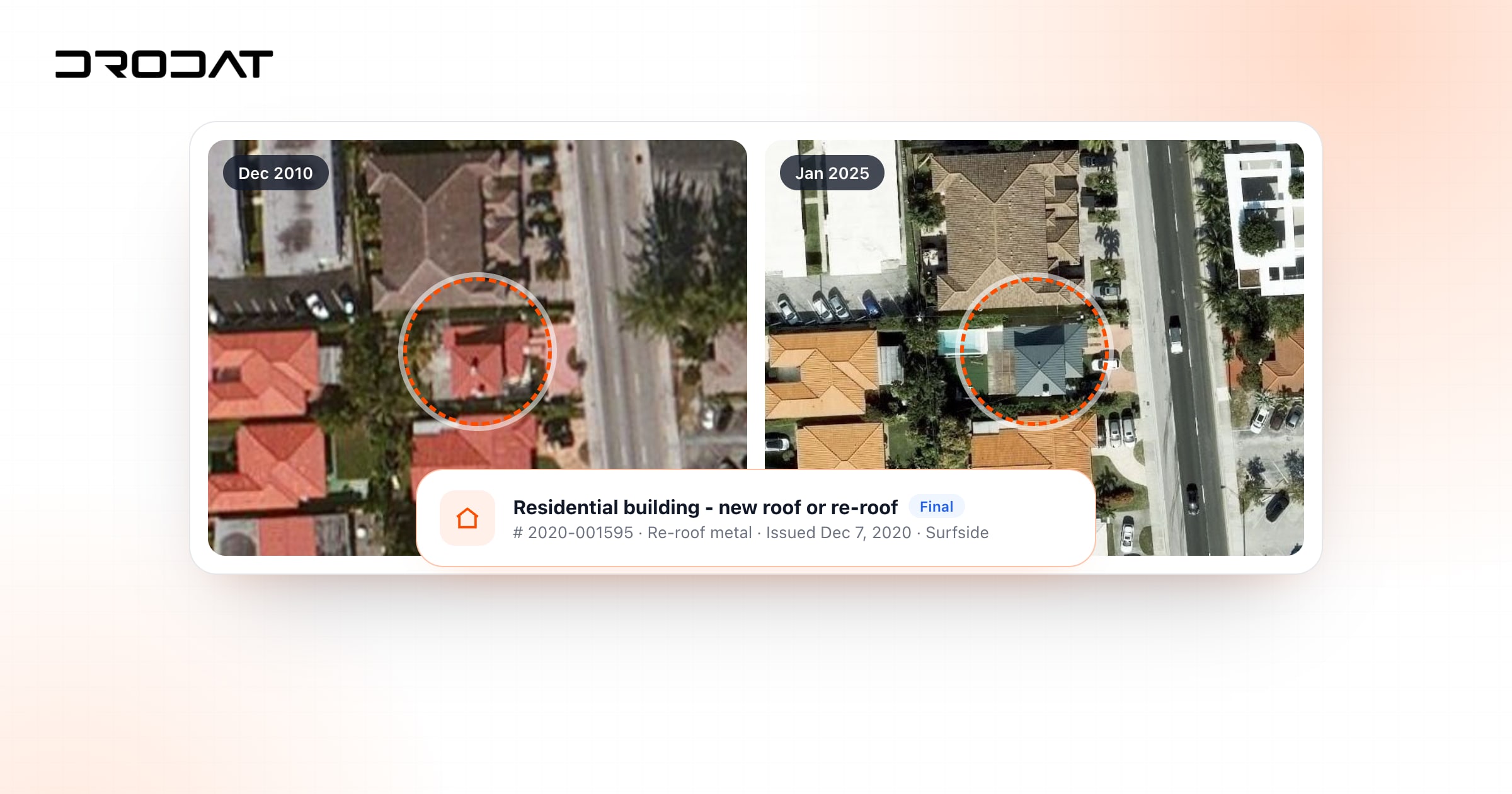
A recent, finaled roofing permit with passed inspections is strong evidence that the roof was in good condition before the storm. Pair it with historical aerial imagery from the same period and you can show the new roof going on, and the roof intact before the loss.
3. Confirm what was built, and when
Additions, pools, and electrical or plumbing work on record explain what is on the property today and when it was added. That matters when a carrier questions a structure, a square footage, or whether a system was original to the house.
4. Plan for code upgrades
When damaged parts of a building are repaired, current building codes can require upgrades that go beyond the original construction. Knowing when the roof and major systems were last permitted helps you spot those upgrades early and review the policy’s ordinance or law coverage. Dex can find the exact ordinance or law language in the policy for you.
A real example
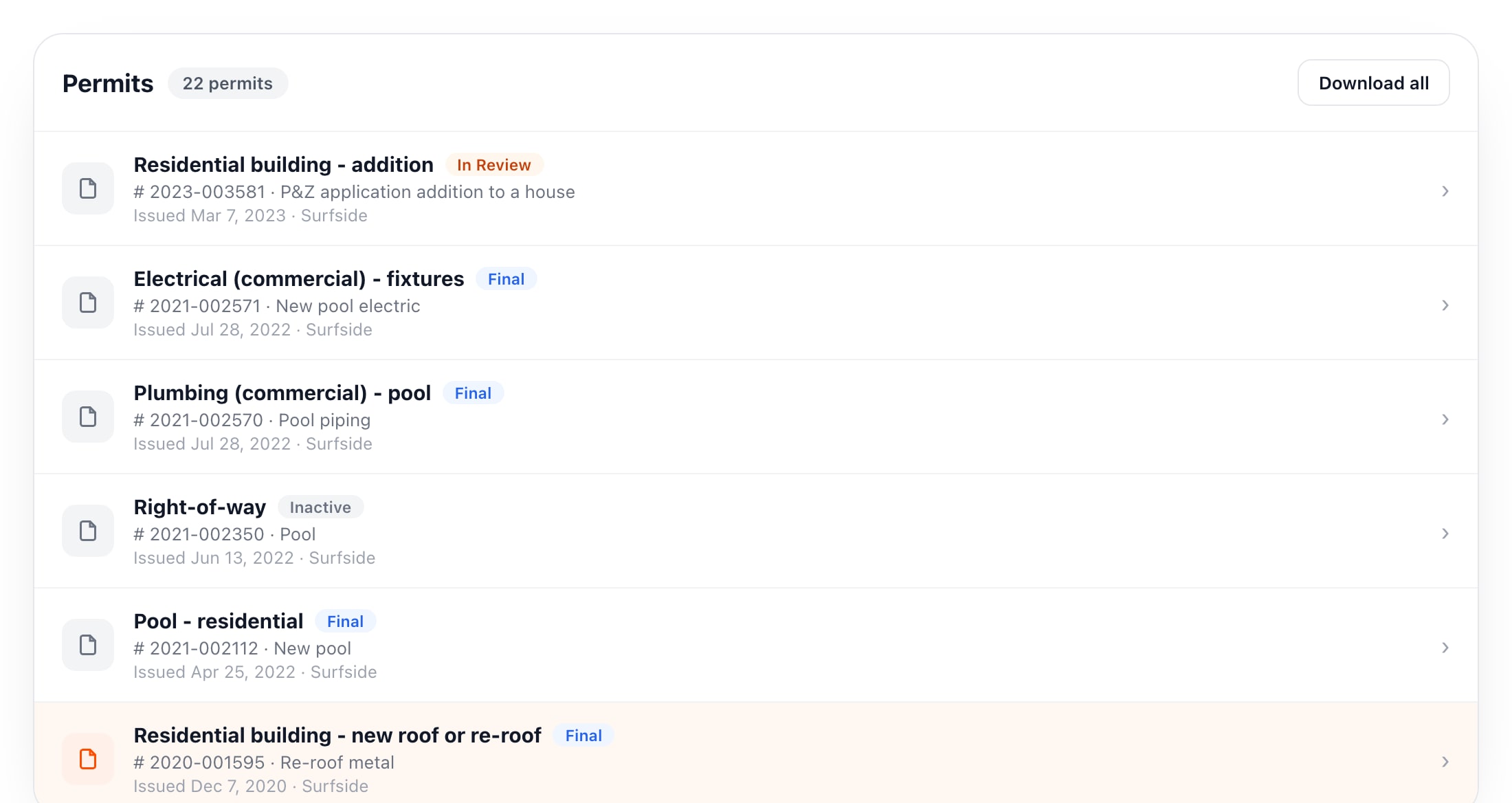
Drodat’s demo property in Surfside, Florida has 22 permits on record. Among them:
- A residential re-roof permit for a metal roof, issued December 7, 2020
- A residential pool permit, issued April 25, 2022, with the matching pool electrical and plumbing permits issued July 28, 2022
- A residential addition application from 2023
On a roof claim for this property, the re-roof permit shows the roof was about five years old in 2026, not original to the house. Step through the property’s aerial captures and you can see the change for yourself: a different roof in earlier years, and the metal roof after 2020.
How to get permit history for a property
You can request permit records from the local building department, but it can take days, and every jurisdiction works differently. In Drodat, permit history is already on the property:
- Open the property. The Permits tab lists every permit on record for the address, newest first, with a total count.
- Filter by category. Narrow the list to roofing, HVAC, electrical, plumbing, solar, EV chargers, pools and hot tubs, windows and doors, additions, or general building work.
- Open a permit. See its dates, job value, fees, inspection results, and the contractor and applicant on record. The property’s facts, such as year built, building area, lot size, stories, and assessed value, are there too.
- Share the record. Download one permit or all of them. Each permit PDF carries a QR code that links to a public verification page, so the carrier can check it.
What if a property shows no permits?
It means no permits were found in the data for that address. Some jurisdictions keep records that are not published, so the local building department may have more. A missing permit is not proof that work was never done, and it is worth asking the owner for receipts or contracts from any past roof work.
Put it next to the rest of the evidence
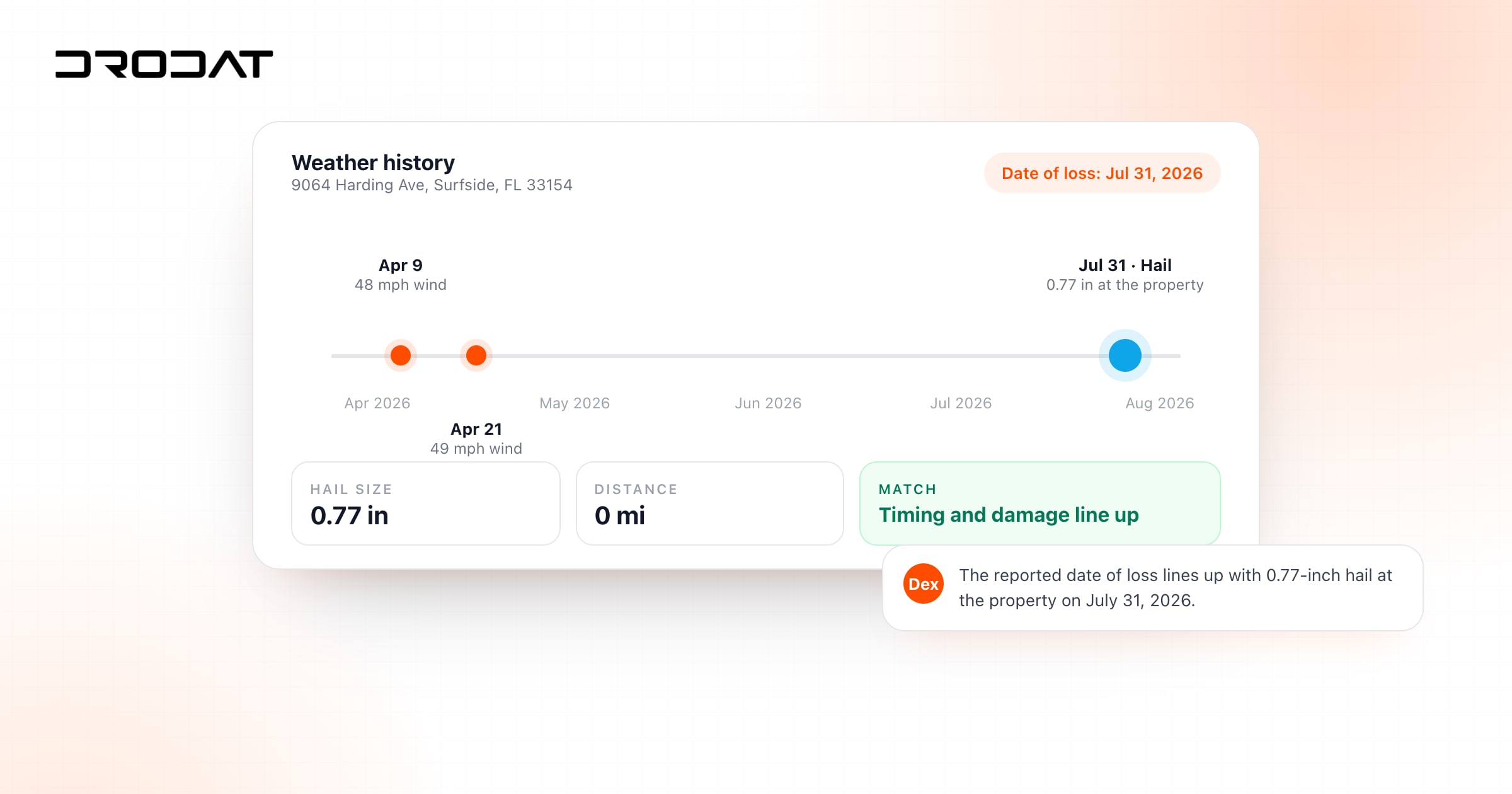
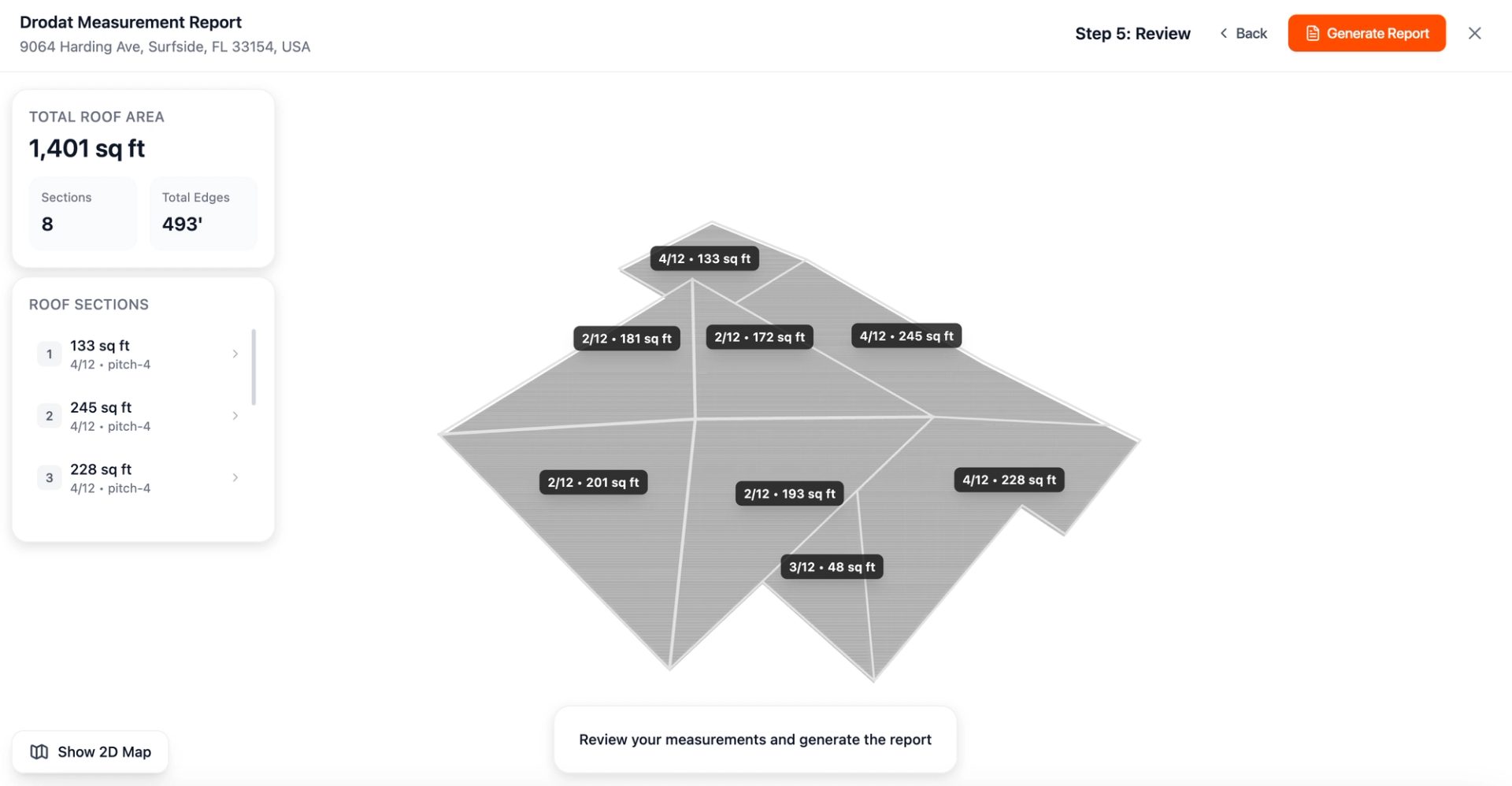
Permit history is strongest alongside the rest of the property record. In Drodat, the same property shows its weather history for the date of loss, its historical aerial imagery, and its roof measurements, all in one place. For the full date-of-loss method, read how to prove the date of loss with weather data.
Try Drodat
See the permit history for any property
Re-roofs, additions, pools, and every other permit on record, with dates, values, and QR-verified PDFs.
Start your free trial
Frequently asked questions
What is building permit history?
Building permit history is the record of building permits filed for a property, such as re-roofs, additions, pools, HVAC, electrical, and plumbing work, with each permit’s dates, status, description, and job value.
How do permits help on an insurance claim?
Carriers depreciate a roof based on its age. A re-roof permit shows when the roof was actually replaced, so it can support a lower depreciation figure than the age the carrier assumed. Other permits confirm what was built on the property and when.
How do I find out when a roof was replaced?
Look for a re-roof permit in the property’s permit history. In Drodat, open the property’s Permits tab and filter by roofing to see every roofing permit with its issue date.
What does a permit record include?
Each record shows the permit type, number, status, jurisdiction, and description, its filed, issued, and final dates, and the job value and fees where reported. Many records also include inspection results and the contractor and applicant on record.
What if there is no permit for the roof?
It means no permit was found in the data for that address. Some jurisdictions keep records that are not published, so check with the local building department and ask the owner for any receipts or contracts from past roof work.
About the Author

Jake Cox
Jake Cox is a co-founder and the CMO of Drodat, the all-in-one claims management and CRM platform for public adjusters and property professionals. Based in Miami, he writes about lead generation, claim workflow, fire and storm prospecting, and the technology shaping the modern public adjusting firm. Drodat powers properties, intakes, contracts, e-signature, projects, financials, NOAA radar storm data, and real-time fire dispatch alerts for adjusters across the United States.